[Impromptu – 1]
Thank you, peace!
Thank you, Win-Win policy!
Gratitude to the founders, supreme guide, and operators of the Win-Win policy who brought peace and complete national unity!
Formation, rest! Attention! Rest!
You have only joined for 4 days? I don’t know … how our alignment is. My habit is that during “rest,” you can listen longer. “Attention”—everyone is just standing at attention, afraid of falling, especially for a long duration.
[Start of the prepared text]
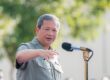
Today, I am truly delighted to join the opening ceremony of the first batch of compulsory military training for the year 2026 here at the Coast and Island Defense Training School (CIDTS). Bringing regards and well-wishes from Samdech Techo and Samdech Kittipritt Pundit, I warmly welcome the honorable presence of Excellencies, Lok Chumteavs, Lok, Lok Srey, distinguished guests, armed forces, compulsory military trainees, as well as guardians, grandmothers, grandfathers, uncles, aunts, and fellow citizens who are participating as historical witnesses to the commencement of Cambodian youth performing their military obligations for the cause of our nation, motherland, and all our people.
I would like to express my profound affection and highest admiration to all the youth who volunteered to fulfill their military obligations and to their families for their courage, steadfast will, especially their awakening spirit and high sense of responsibility in carrying out their roles as citizens who love and volunteer to serve the motherland under all circumstances.
Based on the report by His Excellency General Tea Seiha, Deputy Prime Minister, Minister of National Defense, and Chairman of the National Committee for Military Obligation, under the leadership and coordination of the National Committee, all recruit training schools tasked with training compulsory military personnel have cooperated to organize this first batch of training with a proactive and inter-active spirit, ensuring that the implementation of the Law on Military Obligation proceeds smoothly as planned.
In this sense, I highly appreciate His Excellency General Tea Seiha, His Excellency General Phuong Siphan, the leadership and staff of the National Committee, relevant ministries and institutions, local authorities at all levels, especially the Regional Military Operations Commands, the National Gendarmerie of the capital, municipalities, districts, and Khans, who have closely cooperated and collaborated with consistency under the “Single Body Matrix” approach until achieving these encouraging results today.
[…] The implementation of the Law on Military Obligation is a long-term strategy of the Royal Government in building human capital in the defense sector, especially polishing the intellect and spirit of the youth—who are an “inexhaustible source of human resources”—to love the nation and motherland, respect the law, maintain discipline, and stand ready to serve the nation in all circumstances. Youths who undergo this training will gain experience in self-management, punctuality, practical problem-solving, and living harmoniously with others with fraternity and leadership skills. These youths will become the most robust foundation for national defense.
[Impromptu – 2]
(1) CIDTS receives over 1,000 out of 5,000 compulsory military personnel
The brothers who have joined this batch of obligations and are present here—the Coast and Island Defense Training School (from here on referred to as CIDTS) has received over 1,000 personnel, the highest number. Apart from that, we must deploy them across the Royal Cambodian Army’s recruit training schools, with a total of 5,000 personnel in the first batch, and [another 5,000 in the] second batch. This year we are taking 10,000 personnel according to the Ministry of National Defense’s plan [to distribute] to various units. We split them into two [groups].
(2) The implementation of military obligation for the first time in history and setting standards for subsequent batches
What is special about you standing here is history. First, [this is] the military obligation implemented for the very first time in the history of the Kingdom of Cambodia and the history of the Royal Cambodian Army. Second, out of these 10,000 [personnel], we divide them into 2 batches. This is the first batch. You are compulsory military personnel among those [trained in] the first batch in the history of the Royal Cambodian Army. Let us congratulate everyone. I hope this will be an excellent batch and a batch that sets the standard for subsequent batches.
(3) The name list for the second batch will be released around November 25
According to the report by His Excellency Tea Seiha (Deputy Prime Minister and Minister of National Defense) […] we have over 10,000 volunteers. However, this year we accept 10,000 personnel. Next year we will continue [selecting more]. Implementation begins annually. Those selected this year will serve starting from 2026 for a duration of 24 months. Those whose names are not yet included will be selected subsequently. Do not rush to ask, “Why isn’t my name there?” You will eventually enter. Among them, according to our report, the second batch name list will be released around the 25th [of November]. The list of another 5,000 personnel will be released […] and they will enter the second batch […] starting at the end of February or early March.
(4) In principle, approaching the time, district gendarmerie and district military offices will accept applications
Yesterday evening, I asked the committee to report on when the second batch will begin. They added up the numbers and submitted them, stating it would be implemented on February 30, 2027. I said, “No need at all!” February has at most 29 days, and 2027 only has up to 28 days. If you take February 30, it means it will never start. The person who added up those numbers is even a Major General. I will not mention names. Aside from that, our committee will continue registration. In principle, according to the committee’s report, as it approaches the actual application acceptance period, it will be implemented just like this year: the district gendarmerie and district military offices will accept applications.
(5) Volunteer youth joining compulsory military service can register online
Meanwhile, brothers and sisters who volunteer can register online. Data will be collected. When selection time comes next year, priority will be given to those who registered online. The remaining slots will be filled according to the mandatory service list. Please continue organizing for volunteer youths who could not apply this year to continue registering. This is a principle. The Ministry of National Defense’s committee will provide further details. I have seen questions asking: What should one do if they apply too late? How can one apply? Because the district military offices cannot remain open for applications year-round; they open only for a short period—[such as] 10 or 15 days—to accept paper applications, during which time we continue online registration for our other youths who intend to join military service voluntarily.
(6) November 9 is both National Independence Day and the Birthday of the Royal Cambodian Army
The word “obligation” means that if one does not volunteer, everyone must be conscripted. But we prioritize volunteers first. If you want to enter early and get it over with so you can move on to other things, submit an application. We will give priority. This is the principle. Normally, we open training sessions in the morning, but today we open in the evening. This is because today is our historical day. November 9 is Independence Day and also coincides with the birthday of the Royal Cambodian Army on November 9, 1953.
(7) The first Military Obligation Law was issued in 2006; circumstances prompted implementation in 2026
We have considered the military obligation law since the 2000s. The first law was issued in 2006. Due to circumstances and priorities at that time, we had not yet implemented it. We have brought it up for implementation this year. We amended certain points of the law to suit current conditions and implemented it this year, setting November 9. The [first batch of compulsory military training] was organized to fall on November 9, the army’s birthday. This is the meaning and a special case for you who are present in this first batch. If it is a special batch, you must be special too. I hope that all 5,000 people who entered in the first year will strive and persevere until completing their 24-month obligation as an example for future generations of compulsory military personnel.
(8) The challenges for compulsory military personnel are changing their lifestyle, living under regulations, and changing how they work
I do not need to beat around the bush. I want to tell the truth: you will face challenges. [Even though] you will receive good things, benefits, and new knowledge, we still face challenges. The first challenge is changing from a civilian lifestyle—such as some people being used to sleeping until 10 AM or going to bed after midnight—to sleeping, walking, standing, and sitting under management. That is our challenge. Second, living under clear regulations. The army is discipline […] An army without discipline has no strength. We work as a team. Third, changing how we work. In the past, some people worked entirely alone. They didn’t like working with others. Entering the army, [teamwork] is unavoidable.
(9) Wearing the exact same uniform, hardening physical fitness, and mental spirit
Starting from day one, you have tasted it. In these four days, you know how to “rest” and “attention.” What is called a uniform? It is discarding individuality. It means wearing the exact same uniform. Waking up at the same time, doing everything the same. Helping each other. This is a challenge. But it is also an opportunity. Changing from a mindset of competing against each other, taking wins and losses, to competing as a team, uniting to strengthen oneself and strengthen the team. This is what must be faced. [You must have] physical and mental hardening. You might say that right now, you cannot run 10 kilometers. Therefore, you cannot avoid having to run 10 kilometers until you do. Training is sharpened at that time.
(10) Abandon habits, build individual strength, unite during the hardest times, move forward, and never leave anyone behind
What does that mean? We must place ourselves under pressure, abandon comfort, and in return drive ourselves, drive our will, [abandoning habits of] having absolute freedom in every way. In some places, out of excessive love, mothers do not even dare to use harsh words. Coming here, the instructor says—the leader shouts—you must go. That is a challenge we must undertake: discipline, order, strong orientation, not only physically but also mentally and emotionally. This is individual strength. It is mental and emotional strength, and especially uniting during the most difficult times, moving forward together, and never leaving anyone behind.
(11) The first three months train the transition from civilian habits to in-school soldiers, and 21 months sharpen them into true soldiers
In initial training, obligation has 2 phases. The first phase has a duration of 3 months, which is training to transition from civilian [habits] to in-school soldiers. After the 3-month phase ends, you must face 21 months across various units. You will live, sleep, walk, stand, and sit under rules and discipline even stricter than school. That is 21 months of responsibility, 21 months of further hardening, 21 months that will sharpen us from civilian [habits] into true soldiers. Some people ask: Why is the obligation as long as 24 months? 3 months of training is enough, or 6 months is enough.
(12) Not just physical training, but training both physical fitness and military tactics
Please understand, it is not just learning military tactics. It is learning the military. Sharpening humans into military personnel. [In] the military, tactical training and physical training are only a small part. Here, you will be taught under the meticulous and strict management of instructors. But when you go out to various units, you will live not under 24-hour supervision, but you will be assigned tasks, given authority, given responsibilities, and lead yourselves daily for another 21 months. This is called training an army. It is not training physical fitness or training soldiers; it is training the army—training both physical fitness and tactics.
(13) Fulfilling frontline military obligations so that each soldier, after completion, knows the true life of a soldier
The important thing is training discipline, character, and responsibility, the lifestyle that we practice regularly in military units, especially undertaking operations, taking responsibility, balancing work and living conditions, and procedures. This is [what you will encounter during] those 24 months. Some people think: Why not just [train for] 3 months? … [It is not] short physical training courses. [Compulsory military personnel must] train and fulfill frontline military obligations so that every youth, after finishing their obligation, knows the true life of a soldier, beyond just the first 3 months of training. We will have additional training, but generally, military life, living in the armed forces, and fulfilling duties—whether in units or various missions—carry distinct additional responsibilities.
(14) Upon completing the 24-month obligation, you can enter civilian work or apply to continue as a professional soldier
This is the 24-month hardening to prepare you. Upon finishing the 24 months, [compulsory military personnel will] go out to do civilian work. Some continue as professional soldiers by applying [and undergoing] evaluation accordingly. When returning to civilian life, you [will bring along] the habits of sleeping, walking, standing, and sitting for those 24 months, which are disciplined. Even though freedom returns, it remains ingrained in our brains. Responsibilities remain, having been hardened, having made yourself struggle, having woken up at 2 AM or 3 AM, having been woken up by instructors at night, having gone on operations through wind and rain, having [taken duties] during holidays […] Previously, during holidays, people went dancing everywhere. Now, during holidays, you must stand and guard security for youngsters to dance.
(15) The core duty of the Royal Cambodian Army is training and preparing for operations upon order to defend the territory
To participate in protecting order, the Royal Cambodian Army has the core duty of participating in training and preparing for operations upon orders to defend the territory. But it also participates in operations supporting the maintenance of security, supporting the gendarmerie, and supporting the National Police in certain security tasks. We will take responsibility and execute work. This is the life you must face for 24 months. You ask how to struggle through these 24 months? Entering the first 3 or 4 days feels somehow wrong. Used to sleeping past 10 AM, but at 2 AM the leader wakes you up. I felt the same way too. At the school for 4 years, those 1,000 days, on the first day I started counting down the days.
(16) Success from day to day, task to task, obstacle to obstacle will be the success of 24 months
However, we should think like this: to succeed for 24 months, [we just need] to succeed day by day […] make sure that for that single day you fulfill your duties and prepare for tomorrow steadfastly. Added together, in the blink of an eye, it’s 700 days. Is anyone counting down the days yet? Not yet? To succeed for 24 months, focus on succeeding day by day. To succeed day by day, make sure that from waking up in the morning until going back to sleep, you fulfill duties meticulously, study well, train well, and implement discipline well. That is success. If upon facing a slight challenge you cannot run away, 700 days from now you will run out of breath. We can do everything. The secret is that. Succeed from day to day, succeed from one task given by the leader to another, succeed from one obstacle to another. That is how we will succeed in 24 months.
(17) Do not think of it as spending 2 years of life, but as investing 2 years in your life
Whatever the challenges, absolutely do not give up. What will I say so you don’t give up? We entered military obligation. If you give up, the law will catch you and bring you back. Do not let them catch and bring you back […] Voluntary obligation or conscripted obligation is obligation under the law of obligation. Do not be afraid. We have made this decision. Most importantly, do not think we are spending 2 years of our lives. Think of it as investing 2 years in our lives. Spending and investing are different. Spending means we use it up and get nothing back. But investing means we put in capital and get returns. What capital do we put in? We invest time. We invest willpower. We invest effort for a period of 2 years. We do not spend it uselessly. What returns do we get from this investment?
(18) Compulsory military personnel have had the opportunity to serve the motherland, train their capabilities, and learn military technical skills
Families as well, parents as well. [Think of it as] the children investing 2 years. First, most importantly, they get the opportunity to serve the motherland. This is the greatest opportunity for those who enter the military. Entering the armed forces gives you the opportunity to serve the motherland. This is an investment venture you receive in the military ranks. Second, we get the opportunity to receive training and fulfill skill capabilities, both military and various technical skills that the military can provide by specialty. The military does not just have the skill of holding a gun to shoot. There are many skills. Combat arms have infantry, tanks, artillery, air defense. These are all skills that are learned additionally. Even infantrymen now have had to be trained in drones, trained in various other things.
(19) Compulsory military personnel study subjects that civilians cannot teach, yet are beneficial in the civilian sector
Infantrymen are trained in weapon techniques, trained in other things that civilians cannot learn. All of these have benefits in civilian life. Combat support skills include engineering. Engineering training in the military—in some places it is higher than external engineering. External engineering mostly talks about construction like bridges, roads, buildings. Military engineering also does those parts, but it also does combat engineering, trenches, and obstacles that civilians cannot learn. Chemistry, intelligence, supply service, logistics, finance, medical, technical skills. This is the opportunity in the military.
(20) Investing 24 months will train military personnel in various different skills
What I bring up here is not exhaustive. The word “in the military” does not just mean training for 3 months to know how to shoot a gun and squad, team, individual, and platoon tactics, but knowing much more. Such as communication radios, learning electronics, computers that we can do. So, investing these 2 years or 24 months, you will be able to receive training according to different skills. Some are infantry specialists. This batch has a lot of infantry. In the future, there will be batches entering to fill artillery specialties and other specialties where those who finished high school learn additional languages and computers where possible. This is what you receive.
(21) Compulsory military personnel have had the opportunity to develop discipline, order, responsibility, and leadership
Second is the opportunity for self-development. Aside from hard skills, there are soft skills: discipline, order, responsibility, and leadership. Private schools do not teach these. They exist only in the armed forces. It teaches from being an individual, a soldier responsible for oneself. To be a leader of others, one must first know how to take responsibility for oneself. Then squad leaders, group leaders, etc. Discipline, living, sleeping, walking, standing, sitting according to discipline and time. Responsibility and leadership are crucial tasks. In school, instructors pressure you, sit and watch, guard or not guard, but when you go out on missions, doing your own work outside the unit, when it is time to stand guard, you must stand guard meticulously. This is responsibility. You don’t need leaders walking around checking or placing cameras to watch. This is leadership and responsibility that you will be cultivated with.
(22) A 24-month investment will at least help compulsory military personnel have job stability
This 24-month period makes us adapt […] about three months you might say you aren’t used to it. When you stay up to 21 months, you are used to it. That pattern is what you take back to civilian life. Third, speaking of at least job stability. You have a 24-month job, guaranteed for 24 months. The Ministry of National Defense is your unit. So, there is no need to worry. Working in the civilian sector means running up or down with the economy. Entering the military with obligation means 24 months. Every month, the allowance enters your bank account. No difficulty with fluctuations. So [we have] 24 months of job stability. I do not want to go into what benefits exist, as they have already been explained. But job stability is the basis.
(23) Upon completing the obligation, names are transferred to the “Reserve Forces” until age 45
Fourth, upon completing the 24 months […] your names will be transferred to the reserve unit as reserve personnel until the age of 45. This means you go out to do whatever work you do. Those who finish their obligation have two choices. Choice one: if you love the military, you can submit an application to request becoming a professional soldier. At that time, the unit evaluates whether you can continue, according to the unit’s needs. We think that in the future, the vast majority of newly recruited soldiers will come directly from compulsory military personnel, except for certain specialized skills.
(24) Being hardened and selected as a professional soldier means being a “seasoned soldier” who knows and agrees to live in the military profession
Because of this, priority must be given first to compulsory military personnel to be selected as professional soldiers. This is the future direction. Most of the priority. So he has already adapted for 2 years in [military] life. He has already decided whether military life is his life. For military units as well, after finishing the 2-year obligation, when soldiers submit applications, it means it is less difficult because those 2 years are enough to make a seasoned soldier. More can be taken […] at least he knows and has decided that he agrees to live in the military profession […]
(25) After completing obligation, whether going to civilian work, continuing studies, or pursuing any business, one still bears the name of reserve soldier
However, if you do not join, if you go out to a unit, go to civilian work, continue your studies, or pursue something, your name is recorded as a reserve soldier. We will consider in the future how to organize reserve units, for example, calling them back for 1 or 2 weeks of training/refreshers per year, or however. That’s it. Apart from that, go back to work or whatever. We are considering and disseminating policies for the future.
(26) Reserve forces, active forces, professional soldiers, and compulsory military personnel combined make a large number
Thinking this way aims to ensure that in the future, reserve forces, active forces, professional soldiers, and compulsory military personnel combined will be large in number. Most importantly, the 24-month training here, which I said is not just learning weapons and your specialty, but importantly, hardening and instilling mindset, discipline, order, becoming good human resources for the future—whether going to the private sector or taking state framework exams, you also have a foundation originating from the military. Coming out of the military, you have certain foundations, especially the foundation of endurance, effort, and teamwork. This is what all institutions, whether civilian or military, want.
(27) Military service is an opportunity to learn, train in skills, and become strong human resources for the nation and family
Do not think of it as a 2-year expense. Think of it as a 2-year investment for the opportunity to serve the country and at the same time the opportunity to learn, train further, acquire knowledge to become strong human resources of the nation and family, and so that in the future you have many choices, such as wanting to be a soldier you can be a soldier, or finishing from the military you go out to take police exams or join the gendarmerie with a ready foundation. Yesterday in Poland, a policeman who shot a terrorist shooting people in the city was a former paratrooper soldier. After finishing from the military, he joined the police. So it does not close our opportunities.
(28) Two years in the military trains and pushes people to overcome difficulties, moving out of comfort to trust oneself that it can be done
If we want to do civilian work, we can do civilian work, do anything. Especially [having experienced] difficult work, like entering the jungle, we say we’ve done it for 2 years in the military. No longer afraid, no longer worried. The leader says to work during holidays or whatever […] I say I’ve done it, it’s fine. I can handle it. That is training people, pushing people to cross over difficulties, moving away from their comfort zone to what they can do. When we have reached [those hardships], in our minds we are no longer afraid to go there. That means having jumped a 2-meter fence which previously required a dog chasing you to jump over, but now instructors make you jump—a 2-meter fence is done. So next time we have an obstacle, we say we used to do it, we trust ourselves… this is what you must do.
(29) Whether voluntary compulsory military personnel or conscripted by order, respect and implement the obligation law equally
How are voluntarily compulsory military personnel and lottery-conscripted military personnel different? The difference is one voluntarily registers, submits an application, and sends his name to the Ministry of National Defense and the committee, and gets first priority in selection. Those conscripted are those whom the Ministry of National Defense and the Obligation Committee say: now we need troop. Here is the list of youths whose names were drawn to fulfill their obligation. That is the only difference. One applies voluntarily, the other must comply by order or conscription. But once inside, they must respect and implement the obligation law equally. It is not that volunteers are exempt from the obligation law: “I can quit whenever I want.” It is not like that.
(30) After serving the country for 2 years in the military, taking skills to serve the civilian sector is serving the country for life
Now, how many people want to quit or not? Surely none. I know. That question surely won’t have anyone raising their hand, because if you wanted to quit you probably wouldn’t raise your hand, you’d pack your bags tonight and leave. Fulfilling obligation, even if you pack your bags and leave, you must be brought back. Obligation is different from non-mandatory volunteer soldiers who entered the profession previously. This is fulfilling obligation. Consider the 2 years as an investment to gain additional returns, the greatest of which is the opportunity to serve the motherland. I saw the question: Why enter [military service]? It said voluntarily entered. Want to serve the country. Now the country has provided the opportunity. Do not give it up. Persevere. You enter to serve the country for 2 years; when you go back out, you [bring] skills to serve the country in the civilian sector as well. That is serving the country for a lifetime. This is the opportunity that starts on day one of military obligation here.
(31) Compulsory military personnel have a fixed 24-month term and no ranks are arranged, but it counts as work seniority
How are compulsory military personnel and professional soldiers different? First, the duration of service: compulsory military personnel serve only 24 months. Professional soldiers have the law and statute of the Royal Cambodian Army. What rank they reach, and what age they must retire. Second, rank: for obligations, we do not arrange ranks. Only professional soldiers have corporal, warrant officer, lieutenant, etc. When you finish your obligation, if you want to continue, apply to become a professional soldier. But the work seniority of this obligation is also added to employment. The Ministry of Labor must count it as working time as well. Later when doing civilian work, retiring also counts the days including the 2 years of obligation. It must be like that. We cannot let them lose out. Therefore, they do [obligation] for 2 years and then go out to civilian life. That year must be added up to seniority [of obligation]. If he re-enters the military, to do something else, it must be counted as working years to be added in the future for other benefits, for retirement.
(32) Between compulsory military personnel and professional soldiers, duties and responsibilities as soldiers of the Royal Cambodian Army are the same
Compulsory military personnel can apply to become professional soldiers upon completion through evaluation. What is the same between compulsory military personnel and professional soldiers is that duties and responsibilities as soldiers of the Royal Cambodian Army are identical; there is no discrimination about obligation or non-obligation. When going out to fulfill duties, everyone must think the same way. [It is not that] this task is for obligations. Think of him like a private soldier. Think of him as a soldier. Tasks must be assigned equally. There is no division saying one platoon has two professional platoons and one [obligation] platoon. Everyone is considered the same. There is no discrimination. Except for slight differences in allowances, apart from that, benefits are all the same. But we should not think about benefits in that sense; we think about the benefits of training, being assigned, and task assignment—it must be identical whether professional or compulsory, it must be one…
(33) Units receiving compulsory military personnel for attachment are to implement the principle of non-discrimination
Initially, we considered—the obligation [military] working group discussed designing insignia or rank badges for obligations. We discussed it and said we won’t do it. If we do it, it separates them, meaning splitting them into two directly. Privates, corporal, compulsory military personnel are privates alike, so identity, badge symbols, etc., we must not let them split. I ask all units receiving compulsory military personnel to [train/attach them], all commanders to implement this principle. Absolutely no discrimination. They are soldiers of the same Royal Cambodian Army. Let it be clearly announced. Just like we think about commissioned officers. Some officers graduate from school, some officers do not graduate from school, but when they rise in rank, they are considered the same. There is no discrimination.
(34) Organize the management of compulsory military personnel and professional soldiers to increase strength, solidarity, and synergetic power of the Royal Cambodian Army
Compulsory military personnel and professional soldiers who enter work must receive management, opportunities, and responsibilities just like everyone else. This is the guarantee. We do not arrange it to break internal solidarity and unity. On the contrary, it increases strength, enhances solidarity, and creates the synergetic power of the Royal Cambodian Army through increasing compulsory military personnel, giving soldiers the opportunity to serve the army and country for a short term, training and educating them, which in this sense is what we do. Under this formula, if we recruit 1,000 professional soldiers in 10 years, we only have these 1,000. But if we recruit 1,000 a year, in 10 years we will have 5,000 because they rotate out every 2 years as human resources who have received training and will go out nationwide, without the state needing to increase units and burdens much, since those who trained in those skills will be stationed around the country […]
(35) Having a pre-existing military mindset makes it easy to call them back to update training on various skills
In the future, if there is a [necessity], call them back. Once a year, call them for only 2 weeks for training. They cannot be left like round potatoes [ignorant, incompetent, and unutilized]. That means they have skills, a foundation, and importantly, already possess a military mindset. This is the key point. It is not about having super physical strength or shooting straight. Civilians can also have strong physical strength and shoot straight. But what is different is the 2-year hardening, living, sleeping, walking, standing, sitting in a military manner that not just anyone can do. If you want to go play sports, shoot straight or not, be a civilian and go to a shooting range. You can pay to shoot. But it doesn’t make you a soldier. You can find someone to teach tactics for 2-3 months, but it doesn’t make you a soldier. A soldier takes at least 24 months to know how to sleep, walk, stand, sit as a military person, mindset, character, and military way of thinking. This is military training.
(36) The majority of the first batch of compulsory military personnel will be dispatched to regional military operations commands that are being restructured
So, please, those who asked why not just train for three months to become a soldier, or why not train for only 6 months [to understand]—according to discussions, we dispatch a majority of this batch to regional military operations commands first. Provincial military commands are reforming (with) this batch, and some divisions [as well]. Apart from that, [go] to regional military operations commands to adapt first, and those regional military operations commands must be restructured. Regional military operations commands, after the war, were organized in a reserve format for security work, safety work, or in case of necessity to help reinforce district gendarmerie, district police under the Unified Command Committee. In one military sub-region, we have 16 personnel who are all specialists. There are times when we reinforce them or let them perform other tasks.
(37) National Defense and General Command agreed to dissolve district military offices, transfer security work to the gendarmerie, National Police, and perhaps the community security volunteer forces can join in
In restructuring the army, the Ministry of National Defense and General Command agreed to reform each provincial military command: first, dissolve district military offices. We no longer divide into district military offices of 16 personnel. Previously, 16 personnel was dividing them too small. Work cannot get done. We focus on tasks. Now, the army must sharpen its core task of training and preparing for national defense operations again, and second, support other law enforcement forces in security work if necessary. Security work must be transferred to armed law enforcement officers such as the gendarmerie and National Police, and community security volunteer forces can be added/participate […] In cases of extreme demand, the army steps in to help, such as floods or severe security… apart from that, do nothing else.
(38) Provincial military commands undergo restructuring by sharpening training and readiness for regular operations
Aside from sharpening training and readiness again, all provincial military commands must undergo this restructuring. We have restructured the provincial regional military operations commands out of the Unified Command Committee. Therefore, all management and the Unified Command Committee consist of the gendarmerie, local auxiliary forces, and the National Police who do security work. The army does not do security work as a core task. Regarding law enforcement work, there is only the police and gendarmerie. The army stands ready, reserves training regularly. Instead of being isolated, we gather and organize into subordinate battalions. As for the battalions of the regional military operations commands, we also reform them. Previously we only had one battalion of 250 personnel.
(39) Increase battalion troop strength, equipment, and training, changing according to mission
Now we reform [battalion troop numbers] into three types. Type one: each battalion rises to over 600 [personnel]. Type two: each battalion rises to over 500 [personnel], and type three: each battalion rises to over 300 personnel. Equipment and training also change according to the mission. So, each battalion commander—names will come out soon […] each regional military operations command commander—prepare places to take more troops, organize, gather, prepare readiness, deployment, can deploy as units, responsible by area. But we no longer have 16 personnel in one place, one district. They must be stationed in concentrated units. If not reaching battalion level, at least company level. When something happens, 100 personnel go out at once. Do not go out in 10, 16 personnel. Some of our regional military operations commands had 16 [personnel]. When I was [Commander] of the Army, there were two left. One was retiring. So troops were lacking, combined with having to fulfill duties continuously.
(40) Commanders are to assign roles and pay attention to compulsory military personnel just like professional soldiers
We reform the tasks of the army to concentrate training, operational readiness, equipment, and organizational structure to match [the scale and] support […] Through discussions with His Excellency Tea Seiha [Minister of Defense], His Excellency General Vong Pisen, and Army Commander, we thought that now this first step is to give it first because we will recruit every year. This year we take them to test at regional military operations commands and some divisions. But for the regional military operations commands and divisions receiving them, I ask all commanders: do not split forces, do not treat them as compulsory troops, as second-tier troops. They are first-tier troops just like other professional soldiers; create conditions, assign roles, and pay attention to them just like professional soldiers […]
(41) As lower-grade privates, compulsory military personnel must strive to fulfill duties just like anyone else
You as well. Do not think that being compulsory military personnel means you do not have to work. It is not like that. Compulsory military personnel are not placed as second-tier soldiers. Of course, you are the lowest-grade privates. We have no rank. But we think probably around the level of private. We go and fulfill duties just like everyone else. Do not say “I am young, I cannot do it,” or “Do not bully me as a compulsory military personnel.” Just like everyone else. Strong, persevering, fulfilling duties, fully responsible like other professional soldiers, like other seniors in the unit…
(42) Compulsory military personnel and professional soldiers learn the exact same lessons, same batch, same instructors, same standards
Starting from day one, from now on, military schools do not teach different lessons for compulsory military personnel and different ones for professional soldiers. It is the same lessons, same batch, same instructors, same knowledge. Thus, all standards are the same. This is what we call the benefits of organizing and strengthening our army, including organizing the obligation implementation this year. We have thought about it [without implementing it] for 20 years. Today, this year, is historical that we begin, right on the army’s anniversary as well. This is what I would like to raise regarding compulsory soldiers.
(43) “Parents hope that in 2 years, their children will have more discipline, responsibility, and knowledge than today”
I wish you and your parents well. Today, parents came too. I encourage you. If training gets hard and you want to quit or something [please guide]: your child stays for 24 months. If your child comes home, help bring them back. When your child goes back, don’t let them be called for. Do not let parents be disappointed. You made the effort to enter, you made the effort to wear fine uniforms—seeing some uncles and aunts willing to send their children up onto the truck, waving and smiling at their children, hoping that in two years they will see a child who […] I don’t know what they were like before, but I guarantee that after these two years, you will have discipline, responsibility, training, and much more knowledge than today. Parents want that; that is the army’s guarantee.
(44) “Daring to sacrifice to enter service and conduct national/territorial defense operations … is a major decision”
We are considering: beyond these three months, what training and opportunities will you go through during the remaining 21 months? Before going back to civilian life after finishing the 24 months, what further training must be received? The National Committee for Compulsory Military [Personnel] is considering and preparing how to supplement and coach them upon entry. So, investing two years for the opportunity to serve the country, combined with participating to strengthen the army, strengthen national defense, combined with youth willpower—you are an example to youth and to subsequent generations. This is what they call the meaning of being a soldier. Whether compulsory or professional, you are first someone who dares to sacrifice time and other opportunities for two years to enter and serve the country. Second, if the country needs it, dares to fulfill operations to defend the nation and territory […] This is a major decision. Thank you once again to you who decided to join this first batch as compulsory military personnel for these 24 months. What we have received [for this first batch of compulsory military personnel] is a great pride.
[Back to the prepared text]
With the aim of successfully, transparently, efficiently, and effectively promoting the implementation of the Law on Military Obligation, I would like to provide several recommendations as follows:
- The National Committee for Military Obligation must continue to widely disseminate information about military obligation to citizens, especially youth, so they clearly understand the objectives, importance, value, and benefits for compulsory military personnel, and must organize discussion platforms to address concerns and clarify any negative doubts. Meanwhile, they must elevate the role of youths who are fulfilling military obligation to become educators and advocates for the “value of peace,” especially the flesh-and-blood sacrifices of heroic Cambodian soldiers in the cause of claiming peace and defending territorial integrity.
- Recruit training schools tasked with training compulsory military personnel must strive to create a favorable environment for trainees’ training by providing warmth in living, dining, and fulfilling duties as brothers-in-arms in a single family, as well as organizing activities to forge close emotional bonds. Meanwhile, high attention must be paid to strengthening the capabilities of instructors and trainers, as well as improving training programs, lesson contents, and training methods focusing on technical capabilities including technology use, national defense tactics, life skills, morality, discipline, and patriotism of all trainees.
- School management and trainers must perform their duties with professionalism, justice, good role modeling, and high attention to every trainee, ensuring the quality and safety of training, health, hygiene, and the dignity of all trainees. Meanwhile, they must extract the good experiences of youths who have undergone military obligation to serve as best practices for future generations of compulsory military personnel, and encourage those exemplary veterans to share experiences related to fulfilling military obligation and its value for peace, security, and national defense.
- All compulsory military personnel must strictly respect discipline, orders, and code of ethics, understanding that respecting these conditions is the success of self-mastery and the foundation for achieving life goals, while maintaining solidarity and friendship by helping each other, encouraging each other, and resolving problems together with utmost mutual understanding. Meanwhile, they must strive to study and train attentively to bring knowledge and experience from this training to serve your communities and our entire national society.
Before concluding, once again, I would like to express congratulations and high appreciation to all youth who volunteered to fulfill military obligation participating in the first batch of compulsory military training for 2026 for their patriotism and will to build themselves into exemplary youth and the robust pillars of the nation. We must all participate in strengthening the culture of peace, solidarity, and rule of law. True national defense begins with the unity of the people, understanding one’s obligations, and readiness to serve the nation when needed, in accordance with the slogan “Peace needs protection and self-capacity building.”
Finally, with the official opening of the first batch of compulsory military training for 2026, I wish Excellencies, Lok Chumteavs, Lok, Lok Srey, and all compulsory military personnel abundant good health, family happiness, and success in all work tasks, accompanied by the Buddhist blessings of longevity, beauty, happiness, strength, and quick wit without fail./.