Excellencies, Ladies and Gentlemen, Members of the Senate, National Assembly, and Royal Government, Heads of Delegation, National and International Guests of Honor, and all participants
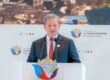
Today, I am truly delighted to join the opening ceremony of the 2026 Cambodia International Business and Investment Forum, an important gathering bringing together foreign investors, factory and enterprise owners, and Cambodian business leaders.
I extend a warm welcome and high appreciation to Excellencies, Ladies and Gentlemen, Oknhas, guests of honor, factory and enterprise owners, and business leaders—especially international experts and investors who have traveled from near and far to explore investment potential and build strong ties with Cambodian investors, factory and enterprise owners, and business leaders, paving the way for genuine trade connections and business matching ahead. I also express my commendation and gratitude to the Cambodia National Trade and Investment Promotion Federation (CamTIPA), international business federations and associations, as well as the organizing committee, national business associations, and stakeholders for jointly conceiving and organizing the 2026 Cambodia International Business and Investment Forum to give domestic and foreign private sectors the opportunity to exchange views, build partnerships, and create concrete investment opportunities.
Cambodia has built a nation and state on a firm foundation of peace, stability, independence, sovereignty, and full territorial integrity, while democracy, the rule of law, and citizens’ fundamental rights continue to be safeguarded and strengthened. Today, national prestige and pride are rising vibrantly as the regional and international community recognizes Cambodia on an equal footing and with equal rights alongside nations around the world. As a result, past cooperation and formal partnerships with the international community have contributed to strategic partnerships and collective bargaining strength in economic development and advancing national interests.
On the national economic front, Cambodia has transformed from a planned economy to a market economy; from an economy almost wholly dependent on agriculture to a broadly diversified economy; and from a country with limited international ties—compounded by economic isolation—to one fully integrated into regional and global affairs. Consequently, over the two decades prior to the COVID-19 crisis, Cambodia’s economy grew at an average of around 8% per year. This high economic growth lifted millions of Cambodians out of poverty nationwide—from the aftermath of the January 7, 1979 liberation down to roughly 10% before the COVID-19 crisis—accompanied by a steady narrowing of economic disparities, turning Cambodia into a lower-middle-income country in 2015 and setting it on track to graduate from Least Developed Country (LDC) status in 2029.
Cambodia’s economic base has shifted from near-total reliance on traditional agriculture to a broad, resilient economic foundation capable of capturing new, high-value industries through the active and timely formulation and implementation of sound, sharp, and well-targeted policies.
As a small, open economy, Cambodia is susceptible to rapidly evolving global trends, particularly five major global currents shaping Cambodia’s socioeconomic development: 1) Shifts in the global order, at both regional and international levels; 2) A global economy increasingly led by Asia, alongside urbanization and aging societies; 3) Advances in science and technology amid the Fourth Industrial Revolution; 4) Climate change and natural resource degradation; 5) Rising borrowing costs for development financing
In this context, the Royal Government will remain highly attentive to further improving the political competitive environment based on democracy and the rule of law, free from external interference in internal affairs; strengthening public institutional capacity and accountability based on checks and balances, meritocracy, and the primacy of national and public interests; and driving efficient, inclusive, and sustainable socioeconomic development grounded in open-market principles and support for the private sector.
The Royal Government will continue to regard the private sector as the “engine of national economic growth” and an indispensable partner in driving national growth—especially at the grassroots level—by boosting consumption and raising living standards through job and skill creation, enhancing efficiency and innovation through new technologies, and integrating Cambodian production into regional and global supply chains by linking backward and forward industries.
Over time, the Royal Government has steadily improved the investment and business environment by upgrading the legal framework, notably enacting the new Law on Investment in 2021; streamlining business and investment service procedures by strengthening the One-Stop Service mechanism, the National Single Window system, and investment aftercare services, as well as launching online business registration platforms, the Cambodia Investment Management system, and the Business Co-Creation mechanism; promoting economic connectivity and market diversification by expanding Cambodia’s integration into regional and global economies and improving transport and logistics systems; Advancing green and digital investment by encouraging investment in renewable energy, energy efficiency, and clean technology; promoting the circular economy, waste management, and efficient resource use; and incentivizing investment in data centers, digital technology, cybersecurity, and IT services.
Currently, the Royal Government is working to modernize Cambodia’s industrial structure from labor-intensive, low-skill industries to skill- and high-technology-based industries by building a competitive, diversified, and resilient industrial base connected to global value chains, integrated into regional production networks, and bolstered by domestic manufacturing capacity. To achieve this ambition, the Royal Government will promote higher-value-added investment and higher-productivity jobs; diversify export products and the mixed economy; strengthen industrial linkages and localization; develop both hard and soft infrastructure; advance technology skills and labor market readiness; and expand appropriate financing—focusing on key industries including agri-food, automotive, electronics, bicycles and parts, furniture, veneer and wood products, digital technology and green energy, infrastructure and logistics, textiles and apparel, and tourism.
On this basis, I encourage the private sector, businesspeople, and all investors to make maximum use of the bilateral and regional free trade agreements to which Cambodia is a party—especially bilateral FTAs with the People’s Republic of China, the Republic of Korea, and the United Arab Emirates, the Regional Comprehensive Economic Partnership (RCEP), and ASEAN+ FTAs, as well as the multilateral framework under the World Trade Organization (WTO)—all of which will support Cambodia in graduating smoothly, inclusively, and sustainably from Least Developed Country (LDC) status in 2029.
[Start of Impromptu Remarks]
At this point, I would like to clarify a few things for our citizens as well as our investors. A few days ago, Laos graduate from LDC status in 2026. I congratulate Laos on graduating. At the same time, some people ask why Cambodia isn’t graduating now, what criteria Cambodia lacks, what issue is behind it, and what else we must do to graduate. We plan to graduate at the end of 2029.
Let me briefly recall that Cambodia was classified as a Least Developed Country (LDC) in 1991. In 2021, we met the graduation criteria for the first time under the three-year review cycle. On the second review in 2024, we were assessed as eligible to graduate and approved for graduation. I recall that in late 2023, Deputy Prime Minister Aun Pornmoniroth submitted a report to me for a decision. At that time, we had two options—once assessed in 2024 as eligible to graduate, we had a preparatory transition window. Option 1 was three years, graduating at the end of 2027; Option 2 was five years, in 2029. Following thorough analysis and study by our relevant policy committees and consultations with partners, we decided to take a five-year preparation period to graduate.
That is why we are graduating in 2029. Why? In plain terms, we don’t want something that merely looks good on the surface without real substance—in colloquial Khmer, wanting both to look good and deliver real results. What does that mean? When we graduate, we must be fully prepared to compete in a new context compared to remaining in the LDC group. The “Least Developed Country” label carries certain advantages and preferences—as Dr. Chey Tech has noted and many citizens understand, such as interest concessions and certain export preferences. Yet the Royal Government has already decided—and I have stated before—that Cambodia has made a strategic decision to graduate from LDC status; we cannot live under the label of a poor country relying comfortably on pity and assistance. We must strengthen ourselves. That was the political direction set by Samdech Techo and carried forward by the 7th-mandate Royal Government: strategically graduating from LDC status in the future to make ourselves stronger. That is the reality.
What matters is the timeline, as I noted—how many years we set to graduate. Before COVID-19, we made substantial progress, but COVID-19 and shifting economic conditions affected our preparation after 2019–2021 and required Cambodia to strengthen itself. Using these extra two years is not about taking two easy years; rather, it is about using time to prepare, negotiate with partners—our Ministry of Commerce, led by Minister Cham Nimul, has been working with European countries and other partners to prepare the ground—so that when we graduate from LDC status, we enter a new competitive environment fully ready. As I said, not just looking good, but delivering real results—pardon the blunt phrasing, since Cambodia shouldn’t sound like a dish that just looks or tastes good, though that’s the simple idiom.
In short, LDC competition comes with certain challenges and certain preferences. After graduating from LDC status, we will still have certain preferences and benefits we can leverage, while facing stiffer competition as some preferences phase out. Even so, it will push us to work harder and create new opportunities for Cambodia to attract external investment and build stronger domestic investment and external markets. That is Cambodia’s decision.
Someone may ask: does Cambodia lack any qualification to graduate? No! We already meet every requirement. Take the three indicators used to assess whether a country can graduate: 1) Gross National Income/Product per capita (GNP per capita): To graduate, a country needs at least $1,222 per person. In 2026, Cambodia stands at $2,750—more than double the threshold. 2) Human Assets Index (HAI): Countries graduating from LDC status need at least 66. Cambodia stands at 77.53. 3) Economic and Environmental Vulnerability Index (EVI)must be below 32 points (reflecting economic and environmental resilience). Cambodia’s score is 22.15—10 points below the ceiling.
So, we already meet all the criteria. Back then, we could have chosen 2027 or 2029, but we chose 2029 so we could prepare better and avoid disruption to sustaining our country’s development. Because each part of our preparation determines whether we face challenges or seize opportunities: if we are underprepared when competing, we face challenges; if we prepare well when graduating, we turn it into opportunity. Will Cambodia’s challenges and opportunities translate into more jobs and investment—or a decline? If we are unprepared, disrupted, and unable to compete, they would decline, hurting our people’s livelihoods and jobs. If we prepare well, graduating creates more opportunities, more jobs, and more investment. That is our decision.
Of course, with two years remaining as an LDC, some people looking only at the title might feel it sounds a bit modest. No—don’t look just at the name or the “Least Developed Country” label; look at the underlying indicators, qualifications, and strategic direction. That is why I am clarifying today for our citizens, investors, and friends that while Cambodia has not yet exited LDC status, our indicators and qualifications already exceed all three required thresholds. Our decision to set graduation in 2029 rather than 2027 is to prepare inclusively, create opportunities, and build stronger conditions and an investment environment so we are ready to serve our citizens and investors even better. That is Cambodia’s decision for 2029.
I take this opportunity to clarify this though most of our citizens understand, some still wonder why Cambodia isn’t graduating in 2026, why it remains until 2029, and what conditions Cambodia still needs to meet to graduate—we already meet them all now. At the same time, all our ministries and institutions must keep preparing even better and more thoroughly so we compete successfully when we graduate from LDC status at the end of 2029.
[Impromptu Remarks Ends]
Before concluding, I wish the 2026 Cambodia International Business and Investment Forum great success and fruitful outcomes for the benefit of Cambodia’s people and nation, and I encourage international experts and investors to explore investment potential in Cambodia—especially by building strong relationships with Cambodian investors, factory and enterprise owners, and business leaders toward genuine trade connections and business matching ahead.
Finally, I wish Excellencies, Ladies and Gentlemen, Oknhas, and all participants good health, family happiness, and success in all your endeavors. I hereby declare the 2026 Cambodia International Business and Investment Forum officially open!